Chyna and Mortez Are Murdered by the Gang
I'm Still Here- What didn't kill me made me stronger and sharperChyna and Mortez Payne Are Murdered by the Gang is the defining loss behind Jensen Brick McCall’s departure from Syracuse and his continuing struggle with guilt. The gang’s killing of Chyna and her young son follows suspicions that she had informed federal authorities; Jensen remembers the violence not as distant news but as a catastrophe he witnessed and believes he failed to prevent.
Circumstances and Violence
The accounts in the novel connect the murders to gang retaliation against informants and to conflict surrounding Chyna’s relationship with someone associated with a rival group. One gang member later calls her a casualty of the war and says that crossing over to Brick Town had effectively written her death sentence. Jensen, however, recalls that Chyna herself admitted to the gang that she had spoken to the Feds. The explanations expose the gang’s code as both a justification for punishment and a source of suspicion: Chyna is condemned as a traitor, while Jensen’s own betrayal of the gang remains hidden from its members.
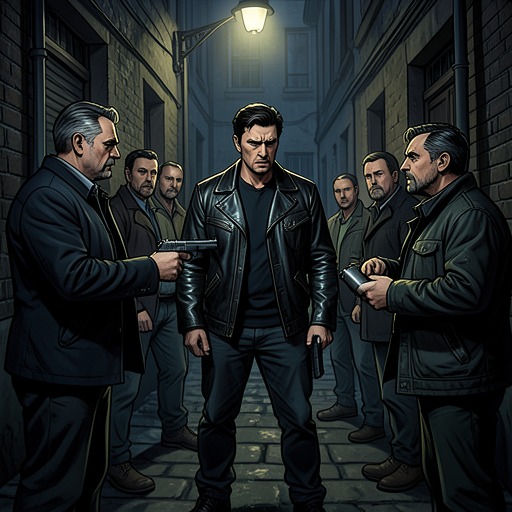
Jensen’s recollection gives the killing an intimate, brutal specificity. He says the gang members took Chyna behind the projects, raped and tortured her, and murdered her; they shot Mortez in the face. In a later confrontation, another gang member describes the assault as a gang rape, followed by torture with a curling iron, before Mortez was killed. The violence is not presented as an abstract consequence of gang warfare: it destroys a mother and child whom Jensen regarded as his family.
Chyna’s final response to Jensen deepens the scene’s conflict between rescue and survival. When he finds the courage to intervene, he tries to offer himself in her place, but she covers his mouth and tells him he is meant to get out of the neighborhood and become somebody great. She says she had also informed on the gang, accepts that she was caught, and insists that her death is not his fault. Her words do not erase what he has seen or the choice he believes he failed to make; they become a plea that he live beyond the violence rather than die with her.
Witness, Guilt, and the Turn Toward Justice
After the killing, Jensen holds Chyna and her son in his arms, closes their eyes, and rocks them. Mortez Payne is still clutching the Transformer Jensen had given him for Christmas. The small toy fixes the scene on a child’s ordinary attachment even as Jensen understands that neither of them can be saved. The next day, he goes to Detective Dartes and reports the crimes.
The report begins a sustained act of cooperation. For weeks, Jensen supplies Detective Dartes and his partner with detailed accounts, videos, and audio recordings of crimes. He describes the decision as a choice between his own freedom and the gang members’ freedom, and understands his betrayal of the gang as inseparable from seeking justice for Chyna. The investigation ends with arrests and the seizure of weapons and drugs; Jensen receives immunity from jail and a bus ticket out of Syracuse.
That departure does not release him from the scene. Jensen calls Chyna the person who remained loyal to him and loved him as he was, especially after Grace McCall died. They had met in the Parkersburg home, where they first joined forces against boys who threatened to sexually assault them; Chyna came to regard him as a brother. Jensen says he had wanted to love her, while she believed friendship was safer. Their closeness makes his memory of her death more than remorse over a failed rescue: he carries the loss of the family he had found, and treats his escape from the neighborhood as an obligation to make his survival mean something.
The Burden of Survival
The murder becomes a measure of Jensen Brick McCall’s own silence. He does not claim to have ordered the killings; he condemns himself for standing among the gang members and failing to save Chyna and Mortez Payne when fear kept him from acting. He later describes that silence as the greatest crime committed by a free man, a judgment that turns survival into a burden rather than a clean escape. Chyna’s insistence that he should live and become somebody great offers him a different interpretation, but it cannot make the memory of the violence or his sense of responsibility disappear.
That burden shapes what Jensen promises himself afterward: he will not again let a woman lose her life without attempting to save her. He links that promise not only to Chyna and her son but also to Grace McCall, whose death compounds his grief. In his account, the losses become a reason to pursue justice and a form of redemption for what he believes he failed to do. The gang’s punishment of Chyna for informing, and Jensen’s own decision to inform the authorities after her death, place his effort to escape within the same dangerous moral world: the choice that helps him secure freedom also confirms that he has turned against the people he once called family.
The setting after the murders gives that conflict a physical shape. Jensen stands in the neighborhood without a home, on ground where the ice has melted around his feet into deep puddles, while other people move toward warm homes. He walks back to the house where Grace once cared for him; its fallen shingles, chipped pale-blue paint, and broken windows contrast with the memories that remain there. He recalls that she found him among babies left to die after his birth, taught him to read, and took him to the library each Saturday. The books and the education she urged him to pursue had helped keep him alive; now those memories accompany his effort to leave Syracuse without pretending that leaving has freed him from Chyna’s death.
Contested Memory and Concealed Betrayal
The gang’s later account tries to make Chyna’s death legible by turning her into a traitor in every part of her life. One member says that she sold drugs to Grace McCall behind Jensen’s back and was responsible for his expulsion from the Parkersburg home, adding that she had used him. Jensen rejects this portrayal and insists that Chyna was like a sister and would never betray him. The exchange does not settle every accusation; instead, it shows how the gang’s posthumous version of Chyna competes with Jensen’s intimate memory of her. Calling her a casualty of war reduces a brutal killing to gang logic, while Jensen’s refusal to accept that account preserves the loyalty he believes she showed him.
The consequences of Jensen’s report also remain hidden from the gang for a time. Gang members later post online about finding the informant who sold out their organization, circulating possible pictures of known snitches, but Jensen’s image does not appear. They assume his departure is connected to the search for his birth mother, a subject he had discussed since childhood, rather than to the crimes he reported. That concealment sharpens the event’s lasting irony: the killings that make Jensen choose justice also leave him carrying a betrayal his former family has not yet recognized.